Think biG!

Urge- Growth Daily

Insights. Opportunities

Intelligence Report

2. EXECUTIVE SUMMARY

Purpose

This Development Intelligence report provides a high-level strategic roadmap for CEOs, Donors, Investors, Government Leaders, and Strategy Teams. It synthesizes current market shifts and policy trends to forecast the regional health landscape through 2030, offering actionable intelligence for navigating the transition from fragmented innovation to integrated national health ecosystems.

A. The Big Thesis

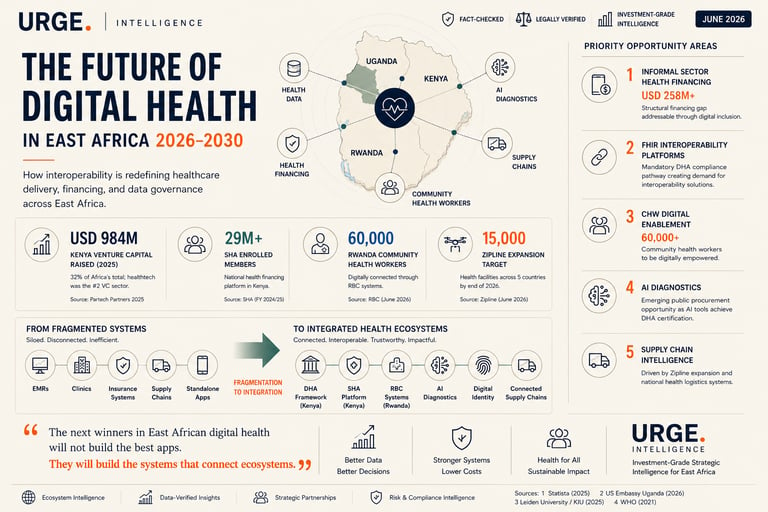
The era of the "digital health pilot" has ended. Between 2026 and 2030, East Africa’s digital health future will be defined by the shift from standalone, proprietary innovations to interoperable national ecosystems that unify clinical care, health financing, logistics, and data infrastructure. Success in this market no longer depends on building the "best app" but on integrating with state-led "Digital Health Superhighways"—such as Kenya’s DHA framework or Rwanda’s RBC-led infrastructure—which serve as the single source of truth for patient and provider data.

B. Key Insights

  1. Institutionalization via Specialized Agencies: Digital health is no longer a sub-department within Ministries of Health but is being managed by autonomous, specialized bodies like Kenya’s Digital Health Agency (DHA) and the Rwanda Biomedical Centre (RBC). These agencies act as both regulators and service providers, mandating certification for any vendor entering the market.

  2. Infrastructure Priority over Standalone Apps: Governments are prioritizing Digital Public Infrastructure (DPI)—including national health product catalogues and interoperability layers—to fix "broken" patient care systems rather than supporting isolated interventions.

  3. Insurance Integration as the Adoption Engine: The modernization of national insurance schemes, such as Kenya’s Social Health Authority (SHA), is driving digital adoption faster than clinical tools. Biometric fraud prevention and mobile-first enrollment are now mandatory rails for healthcare providers to receive government reimbursement.

  4. The Rise of the Digital Community Health Worker: The "last mile" is being professionalized through digital literacy frameworks. In Rwanda, digitally-enabled Community Health Workers (CHWs) already provide timely treatment for 57% of uncomplicated malaria cases, a model being scaled regionally to achieve Universal Health Coverage (UHC).

  5. AI Diagnostics Leading in Private Segments: While public systems focus on infrastructure, AI-assisted diagnostics (e.g., AI-powered TB screening) are expanding rapidly in private healthcare, supported by significant venture capital.

  6. Data Sovereignty vs. Cross-Border Exchange: While the EAC is pushing for digital integration through projects like EARDIP, national data protection laws (e.g., Kenya’s Data Protection Act 2019 and Uganda's PDPO) are becoming more stringent, requiring localized data storage and strict compliance for cross-border health data movement.

C. Top Opportunities

  • Health Financing: There is a massive opportunity in digital health wallets and fintech-linked insurance products that bridge the gap for the millions of people still facing financial hardship due to out-of-pocket costs.

  • Rural Access (DPI4CH): Investing in Digital Public Infrastructure for Climate Health Resilience—systems that track and respond to climate-driven health shocks in rural areas—is a core priority for the World Bank and regional bodies.

  • Data Infrastructure & Interoperability: High demand exists for automated electronic data migration tools and interoperability layers (e.g., HL7 FHIR standards) that can orchestrate data exchange between disparate hospital systems.

  • AI-Supported Care: Scaling AI for infectious disease screening and large language models for health equity in resource-constrained settings.

  • Supply Chain Digitization: Governments are seeking solutions for standardized national product catalogues to improve procurement efficiency and reduce stockouts of essential medicines .

D. Top Risks

  • Fragmented Platforms: Despite the push for unity, many health facilities still operate on isolated Electronic Medical Record (EMR) systems that do not feed into national data warehouses.

  • Weak Interoperability: The lack of strict enforcement of global data standards at the facility level leads to data silos, making individual-level data analytics for epidemic control difficult.

  • Regulatory Uncertainty: Emerging bills, such as Uganda’s Protection of the Sovereignty Bill 2026, create uncertainty around the free flow of foreign investment and health data, potentially impacting multi-country research and development.

  • Funding Dependency: The sector remains heavily reliant on donor "rails," such as the $2.3 billion US-Uganda Health MOU, which can create volatility if geopolitical priorities shift.

E. Strategic Recommendations

For Governments

  • Enforce Interoperability: Mandate that all digital health vendors certify their products against national "interoperability layers" to ensure data portability.

  • Invest in Digital Literacy: Scale foundational digital literacy frameworks for health workers to ensure that hardware distributions result in actual data entry.

For NGOs

  • Focus on the Last Mile: Shift from providing software to providing the capacity building and training required for CHWs to utilize digital tools effectively in malaria and maternal health.

For Donors

  • Support National Health Compacts: Align funding with five-year national roadmaps rather than isolated project-based grants to ensure long-term sustainability.

  • Blended Finance: Utilize blended finance models to de-risk private sector investments in local manufacturing of medical countermeasures and digital diagnostics.

For Investors

  • Target Integrated Ecosystems: Prioritize startups that offer embedded health insurance or specialized AI diagnostics that can plug into existing national registries .

  • Infrastructure as a Service: Invest in vendors providing the "picks and shovels"—broadband connectivity, solar energy for clinics, and secure data storage.

For Healthtech Companies

  • Register as Data Handlers: Ensure early registration with national data protection authorities (ODPC in Kenya, PDPO in Uganda) to maintain market access.

  • Avoid Standalone Models: Design products that are "interoperable by design," focusing on clinical data sharing and automated reporting to government warehouses.

Prepared by Urge Communications: Inspiring Growth, Shaping Outcomes in East Africa.


The Future of Digital Health in East Africa (2026–2030)

Market, Policy & Investment Intelligence Report

Compiled by: Urge Communications

Release Date: May 8, 2026

Region Covered: Kenya, Uganda, Tanzania, Rwanda
Urge- Growth
Dev- News
Urge Skill-Up

Knowledge is power.

Stay connected. Be informed.