Think biG!
Urge- Growth
Development Intelligence & Insights
Development Intelligence & Insights Report
Executive Summary:
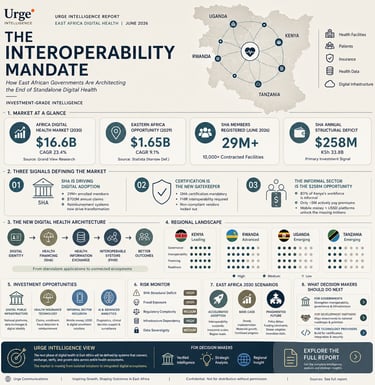
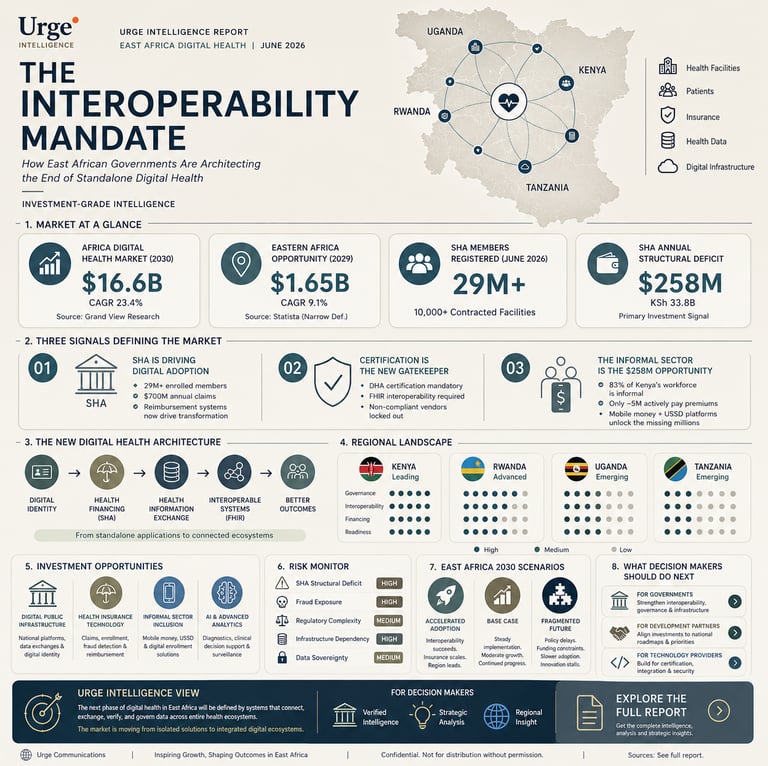
The Interoperability Mandate
As East African nations transition from fragmented digital health pilots to integrated "Digital Health Superhighways," interoperability has evolved from a technical preference to a sovereign mandate. This report explores the structural, financial, and regulatory levers governments are utilizing to enforce a unified data ecosystem. The core thesis is that governments are no longer "requesting" collaboration but are architecting systems where participation is the only path to operation. By centralizing data governance through specialized agencies and linking digital compliance to national insurance reimbursements, the region is setting a global standard for state-led health integration.
2. Governance: Specialized Agencies as System Architects
The primary mechanism for enforcement is the removal of digital health management from general Ministry of Health departments and placing it into autonomous, specialized agencies.
Kenya’s Digital Health Agency (DHA): Established to manage core digital systems and infrastructure, the DHA acts as the technical gatekeeper. Its mandate includes establishing national registries for clients, facilities, and providers, creating a "single source of truth."
Rwanda Biomedical Centre (RBC): The RBC centralizes health data through specialized systems like the CHWApp and RBCNet, ensuring that all community-level interventions report into a single national backbone.
Mandatory Certification: These agencies now require technical certification for all private and public sector vendors. Any digital tool must prove its ability to communicate with the national "interoperability layer" before being deployed.
3. Infrastructure: The National Interoperability Layer
Governments are shifting their focus from "supporting apps" to building Digital Public Infrastructure (DPI). This involves a central Interoperability Layer that orchestrates data exchange between disparate hospital systems (EMRs).
Standardized Registries: Enforcement is achieved through mandatory usage of national registries for health products and facility lists. For instance, Kenya’s Afyayangu portal (30.1M registrations) and the Master Health Facility List (KMHFL) serve as the only valid identifiers for data exchange.
Global Data Standards: Governments are mandating global standards such as HL7 FHIR for clinical data sharing and ICD-11 for disease classification. Systems that do not support these protocols are effectively siloed and denied access to national data warehouses.
Automated Data Migration: To overcome the "data legacy" challenge, agencies are investing in automated electronic data migration tools that facilitate the large-scale transition of data from old, fragmented platforms to the new superhighway.
4. Financial Levers: Insurance as the Adoption Engine
Perhaps the most potent enforcement tool is the digitalization of national health insurance schemes, such as Kenya’s Social Health Authority (SHA).
Compliance for Reimbursement: Providers are increasingly required to use interoperable systems that feed into the National Data Warehouse (NDW) to receive government reimbursements. This creates an immediate financial incentive for private clinics to integrate with the national superhighway.
Biometric Fraud Prevention: The deployment of biometric gadgets in SHA-accredited facilities forces the adoption of standardized digital identity protocols, ensuring that patient data is consistent across the entire ecosystem.
Fintech-Linked Enrollment: Mobile enrollment campaigns and digital premium collection (e.g., Côte d’Ivoire’s model) are being mirrored in the region to ensure that every patient interaction begins with a digitally verifiable identity.
5. Regulatory Frameworks: Data Sovereignty and Privacy
Strict enforcement of data protection laws serves as a legal barrier to non-compliant or fragmented systems.
Data Protection Authorities: Independent bodies like the Personal Data Protection Office (PDPO) in Uganda and the Office of the Data Protection Commissioner (ODPC) in Kenya regulate all processing of personal health data.
Mandatory Registration: All health-tech companies must register as Data Handlers or Processors. Failure to comply with national data standards—particularly regarding localized storage and security—results in the loss of their operating license.
Cross-Border Harmonization: Regional projects like the Eastern Africa Regional Digital Integration Project (EARDIP) are pushing for harmonized cybersecurity and data governance standards across the EAC, ensuring that interoperability extends beyond national borders.
6. Strategic Recommendations for Enforcement
For Policy Makers: Invest in foundational digital literacy for the health workforce. Hardware distribution (e.g., Kenya’s 41,000+ devices) only results in data entry if workers are trained to use integrated systems.
For Development Partners: Align funding with National Health Compacts—five-year roadmaps that prioritize systems integration over isolated project-based apps.
For Vendors: Move away from standalone, proprietary models. Success in 2026–2030 requires being "interoperable by design," focusing on clinical data sharing and automated reporting to state-led warehouses.
This report is part of Urge Communications' commitment to sharing intelligence that shapes growth and outcomes in the East African health sector.
Enforcing Interoperability in National Health Superhighways
Prepared for: Development Intelligence Strategic Teams
Compiled by: Urge Communications
Focus Region: East Africa (Kenya, Uganda, Tanzania, Rwanda)
Urge- Growth
Dev- News
Urge Skill-Up
Knowledge is power.
Stay connected. Be informed.
© 2017 All rights reserved.


Inside Health
Work