Think biG!

Urge- Growth Daily

Insights. Opportunities

Intelligence Report

Executive Summary: The Unified Data Thesis

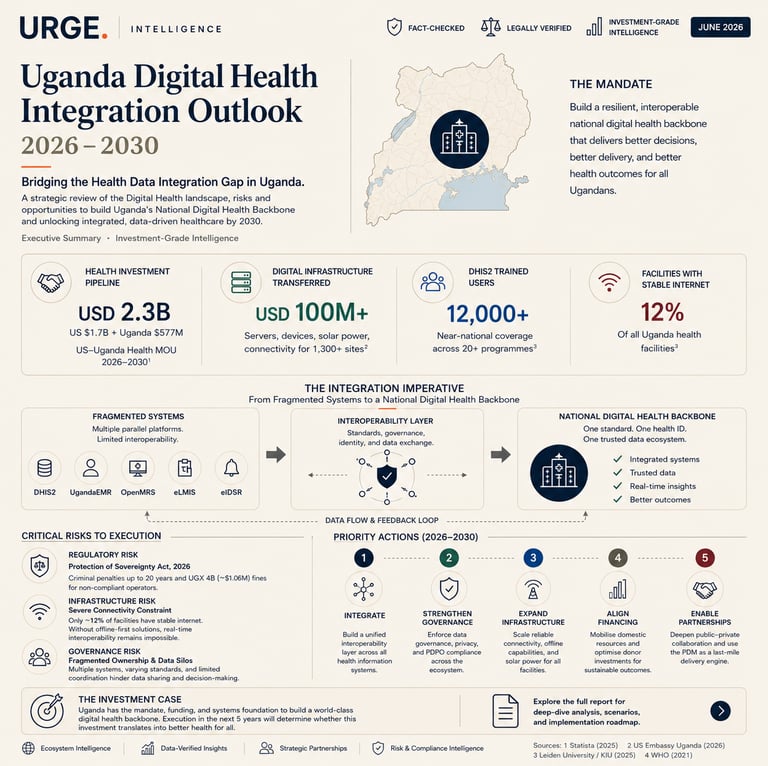
Uganda stands at a critical juncture in its digital health journey. While the country has secured massive institutional support—most notably through a $2.3 billion health partnership with the United States (2025–2030)—it faces a persistent "Deep Integration Gap" where health data remains trapped in fragmented, facility-level silos. To bridge this gap by 2030, the Ugandan government must move beyond being a mere "steward" of health to becoming the "architect" of a National Digital Health Backbone. This report outlines a strategy to enforce interoperability, leverage specialized data governance through the Personal Data Protection Office (PDPO), and utilize financial levers to unify the health ecosystem.

2. Governance: Centralizing the Digital Mandate

The first step in bridging the integration gap is establishing clear, authoritative governance that transcends the Ministry of Health’s general administrative functions.

  • Empowering Independent Authorities: Uganda has already established the Personal Data Protection Office (PDPO) as an independent authority under the National Information Technology Authority (NITA-U). To bridge the integration gap, the government must mandate that the PDPO serves as the technical gatekeeper for all health-tech vendors, ensuring they comply with the Data Protection and Privacy Act No. 9 of 2019 .

  • National Health Information System (HIS) Stewardship: The Ministry of Health must enforce its mandate for strategic planning and setting standards to move away from isolated project-based apps toward a "Single Source of Truth" for patient records.

  • The US-Uganda Joint Health Steering Committee (JHSC): This body, established to oversee the $2.3 billion MOU, should prioritize building institutional and workforce capacity for data management as a core pillar of "Ugandan self-reliance.

3. Technical Architecture: The Interoperability Layer

Bridging the gap requires a move from hardware distribution to a "Software-Defined Healthcare" model.

  • Adopting Global Data Standards: The government must mandate global standards such as HL7 FHIR and ICD-11 for all health systems. This ensures that a patient's data can flow seamlessly from a rural health center to a national referral hospital, like Butabika National Referral Mental Hospital.

  • Automated Data Migration: Drawing from regional best practices, Uganda should invest in automated electronic data migration tools to ease the transition of legacy data from fragmented Electronic Medical Records (EMRs) to the national data warehouse.

  • Digital Public Infrastructure (DPI): Integration cannot happen without connectivity. Projects like the Eastern Africa Regional Digital Integration Project (EARDIP) are essential for increasing affordable broadband access, ensuring the "last mile" clinics can sync their data in real-time.

4. Financial Levers: Linking Data to Funding

The most effective way to bridge the integration gap is to make digital compliance a prerequisite for financial participation.

  • Digitalization of Health Financing: Following regional trends, Uganda should link health service reimbursements to data entry. If a facility does not report its outcomes into the national HIS, it should face challenges in accessing government or donor funding pools.

  • Parish Development Model (PDM) Integration: As the government doubles funding for the Parish Development Model (PDM), there is an opportunity to integrate health data collection into the PDM’s grassroots reporting framework, ensuring health metrics are captured alongside economic data.

  • Incentivizing Private Sector Alignment: The private sector should be incentivized through blended finance models to adopt interoperable EMRs that feed into the national data warehouse.

5. Risk Management: Navigating Policy and Privacy

The push for integration faces significant headwinds that require careful policy navigation.

  • The Sovereignty Bill Tension: The Protection of the Sovereignty Bill 2026 has sparked intense debate . While the government clarified that the "free flow of investment and remittances" will not be affected, there is a risk that overly stringent restrictions on "foreign" influence could inadvertently hamper the cross-border data exchange required for regional disease surveillance.

  • The Connectivity & Energy Gap: Government officials recognize that "the last mile is not fiber". To bridge the data gap, the government must prioritize the installation of solar energy units and decentralized servers at border points and rural clinics to maintain data integrity during power shocks.

  • Workforce Digital Literacy: Distribution of ambulances and emergency vehicles—such as the recent 30 vehicles donated by Japan—must be matched by training health workers to use digital tracking and reporting systems to ensure these assets are utilized efficiently.

6. Strategic Action Framework

To bridge the gap, the government should follow this simplified model:

  1. Enter: Formally integrate the PDPO’s data protection certification into the Ministry of Health’s vendor licensing process.

  2. Partner: Utilize the JHSC to align the $2.3 billion US funding with the creation of a national interoperability layer.

  3. Pilot: Deploy automated data migration tools in one administrative region (e.g., the Kampala metropolitan area) to test real-time synchronization with the national data warehouse.

  4. Scale: Use the EARDIP infrastructure to expand this integrated model to all 135 districts through a phased rollout.

This report is part of Urge Communications' commitment to inspiring growth and sharing intelligence for a better-connected Uganda.

Bridging the Health Data Integration Gap in Uganda (2026–2030)

Prepared for: Strategic Development Teams & Government Leaders

Compiled by: Urge Communications

Focus Region: Republic of Uganda

Release Date: May 5, 2026

Urge- Growth
Dev- News
Urge Skill-Up

Knowledge is power.

Stay connected. Be informed.